
A sales planning is a bit like the key that unlocks a treasure 🪙 it turns a simple vision into concrete results. 🔥
More seriously, it serves as a roadmap for sales teams, and helps maximize their efficiency and results.
But we'll tell you all about it in more detail!
Today's menu chef: 👇🏼
The definition.
The 7 steps to a successful sales action plan.
A concrete example.
Advantages and disadvantages.
The article should take about 5 minutes, so grab a little iced tea and let's get started! 🧋
What is a sales action plan?
It's a strategic and operational document that details the initiatives and various steps a company must take to achieve its sales objectives and strategies. 🔥
This plan is a bit like a tourist guide, giving a clear direction on the actions to be taken with the aim of generating revenue and thus increasing growth. 📈
In general, you'll find in-depth market analysis, targeted customer segments, sales tactics, and performance indicators to measure the effectiveness of sales efforts. 👀
But you'll see, the objectives of a CAP are manifold! 😇
The 5 objectives of a PAC
If you're still wondering what interests you have in using a CAP for your business, well, here they are. ⬇️
1️⃣ Increase sales.
If you want to boost your sales by increasing the volume of products or services sold, then you can launch new marketing campaigns and improve sales techniques.
2️⃣ Improve customer satisfaction and loyalty.
It's always important to ensure that customers are satisfied with their purchases, and to encourage their loyalty in order to generate more sales.
3️⃣ Optimize sales team efficiency.
Increase the productivity of sales teams by defining their tasks, for example, and providing them with the necessary resources.
4️⃣ Identify and exploit new market opportunities.
You can identify and position yourself in new market segments or demographic locations to broaden your customer base.
5️⃣ Increase brand awareness.
Use advertising campaigns and strategic partnerships to strengthen your brand's presence and recognition in the marketplace.
Okay, enough about why you need to use a CAP, let's move on to how to execute it. 😏
The 7 key steps to a successful sales action plan
Now that you've understood the definition of a CAP, I'd like to take a look at the different steps involved in creating a kick-ass sales action. 🔥
1) Analysis of the current situation
This first step is essential: don't skip it, as it will help you understand the context in which your company is evolving, and identify 🔎 potential levers for growth.
There are a number of factors to take into account. 👇🏼
First of all, you can analyze a market study to gather information on current trends and the needs of your consumers.
This can be :
🤔 Surveys.
💬 Focus groups.
🔎 Market analysis.
By doing this, you'll be able to understand and adapt your products or services to best meet customer expectations and needs.
Next, we strongly recommend that you study your competitors, analyzing their :
Strengths and weaknesses.
Offerings.
Pricing.
Market positioning.
But let's go into more detail with two more tips. ⬇️
Use customer behavioral data
Ultimately, it's your customers who buy your product. So it's important to understand how they interact with your products or services! 👀
You'll be able to analyze buying habits, preferences or even purchase triggers.
How can you do this? 🤔
Well, with analysis tools such as :
🔷 Google Analytics.
🔷 CRM system.
🔷 E-commerce platforms.
For example, by studying buying paths, you can identify 🔎 the various friction points and optimize them to improve the customer experience and increase sales.
SWOT analysis
The SWOT method allows you to identify your internal strengths and weaknesses, as well as external market opportunities and threats.
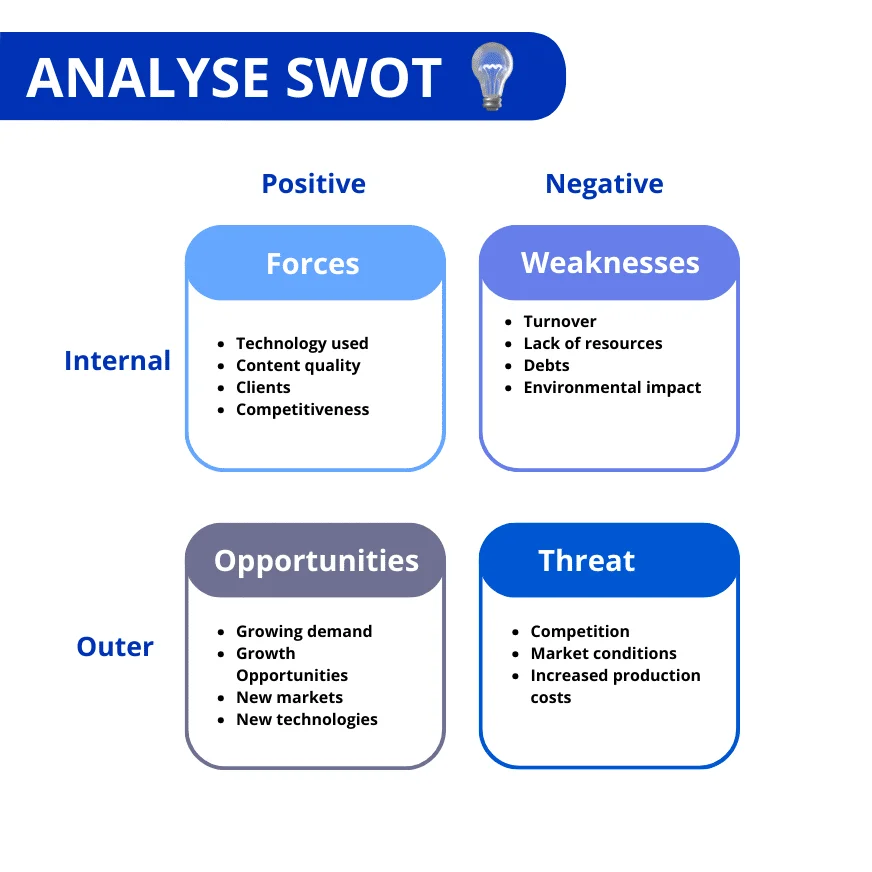
For example, if one of your weaknesses is a lack of online presence, this can become a priority in your action plan.
As you can see, SWOT enables you to develop different strategies based on your strengths and opportunities, while minimizing the risks associated with your weaknesses and threats. 😇
2) Defining business objectives
This step provides clear direction, motivates teams and measures progress. 💪🏼
Here are some examples of business objectives:
Increase sales by 15% by the end of the year.
Acquire 500 new customers in the next six months.
Improve rate by 10% over the next 12 months.
Bring 3 new products to market by the end of the quarter.
Increase average basket by 20% over the next nine months.
To help you define your sales objectives, here are two methods. 👇🏼
Using AI to predict market trends
Artificial intelligence is now an integral part of our lives! And it would be foolish to miss out on such a brain for your strategies. 🧠
Let's find out how AI can be used:
🔎Big data analysis: analyze large amounts of data from different sources (past sales, consumer behavior, industry trends) to identify patterns and trends.
🔮 Accurate predictions: using machine learning algorithms (promise it's not complicated), AI can predict future buying behavior and market trends.
⏰ Real-time adaptation: analyze new data and adjust forecasts in real time.
💟 Personalization: tailor objectives to specific market segments, geographic regions and customer profiles.
SMART method
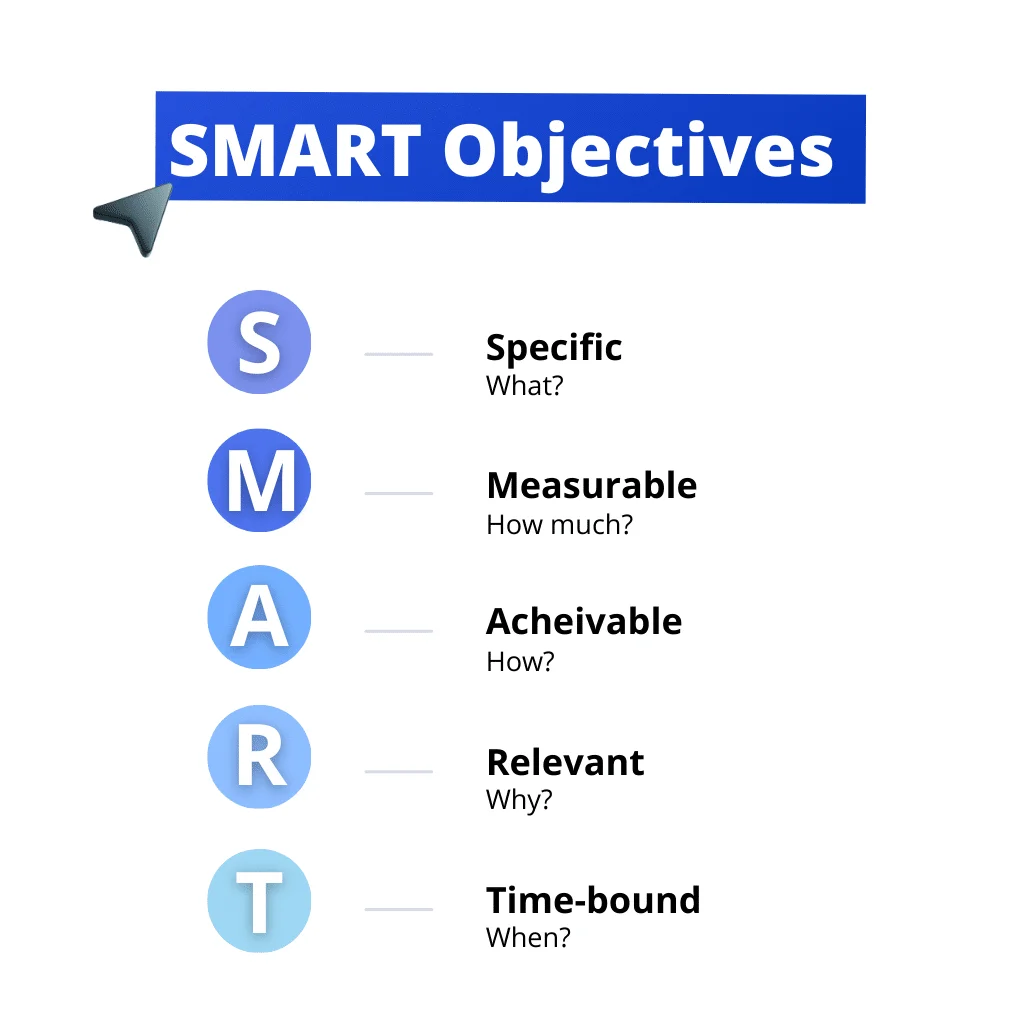
If you don't already know what the SMART method is, it's an acronym that stands for :
Specific: objectives must be clear and precise.
Measurable: measuring progress towards objectives.
Achievable: objectives must be realistic and achievable within the company's resources and capabilities.
Relevant: objectives must be relevant to the company's priorities and ambitions.
Time-bound: have a clear deadline.
Just for your eyes 👁️🗨️, we've combined AI and the SMART method, and here's what you get. 👇🏼
Integration of AI and the SMART Method
SMART criteria | Use of AI |
|---|---|
Specific | Use AI forecasts to identify specific objectives based on market trends. |
Measurable | Define clear KPIs that AI can track and analyze in real time. |
Achievable | Ensure that the objectives forecast by AI are realistic, taking into account the company's internal capabilities. |
Relevant | Use AI insights to ensure that objectives are relevant and aligned with current market opportunities. |
Time-defined | Let AI help determine realistic timeframes based on market forecasts. |
3) Sales organization
This section is used to determine :
🥇 How teams are structured.
🥈 Everyone's roles and responsibilities.
🥉 Communication and coordination processes.
If you build your sales team and organize it well, you'll find it easier to achieve your sales objectives. 👀
But what would a captain be without his crew, or a coach without his team? Well, not much after all... In short, the structure of your team is just as important! 🔥
Team structure overview
That's why we're quickly showing you an idea for a team structure to boost your sales! 📈
1️⃣ Sales management team.
Sales Director: responsible for global strategy, sales and marketing, supervises all sales teams and ensures that sales targets are met.
Product Manager: in charge of developing and launching new products, works with the R&D department and sales teams to align products with market needs.
2️⃣ Sales team.
Sales manager: manages the sales team, sets individual and team sales targets.
Sales representatives: responsible for prospecting, negotiating and closing sales, they are in direct contact with customers.
Sales assistants: support sales representatives by managing administrative tasks, preparing and coordinating customer meetings.
3️⃣ Marketing team.
Marketing Director: responsible for the creation and execution of , working in collaboration with the Sales Director.
Digital Manager: manages all online marketing activities.
Communications Manager: manages external and internal communications, including public relations.
4️⃣ CRM and customer support team.
CRM Manager: manages the customer relationship management system and ensures that all customer interactions are recorded and analyzed to improve customer satisfaction and loyalty.
Customer support: provides assistance to customers before and after sales.
5️⃣ Events team.
Events Manager: plans and organizes company events, such as trade shows, webinars and customer events.
Events coordinator: manages the logistical details of events and ensures coordination between different departments to guarantee the success of events.
4) Target identification
This stage enables you to precisely define the market segments and customer profiles you want to reach. 🌚
To do this, you can start by segmenting your market by defining several criteria, such as :
Age.
Gender.
Income.
Region.
Lifestyle.
Buying habits.
Brand loyalty.
Next, you can create detailed that represent the typical customers in each segment. You can add information such as the challenges faced by customers, their goals, preferences or buying behaviors. 👀
Finally, don't hesitate to use data to refine your research, using analytics tools, for example. 💡
5) Developing your sales strategy
Now that you've got all the ingredients for your recipe, it's time to get to work! 🐾
To do this, we're going to use the sales cycle and its various stages!
Sales cycle stages
1. Prospecting.
The first step is prospecting, which is used to identify and attract 🧲 potential prospects. You have all the cards in your hand with various methods such as database mining, digital marketing campaigns, networking events or even content marketing. 😇
To help you with your prospecting, we recommend using a prospecting tool!
Psiiit, I've just heard about a great prospecting tool called Waalaxy! 👽
2. Qualification.
Next, you have the qualification stage, it means assessing prospects' interest and ability to buy. 💸
In general, you can carry out telephone interviews, satisfaction surveys, or detailed contact forms. 📝
3. Presentation.
Here, we'll present products or services in detail to meet the specific needs of different prospects, for example, through personalized sales demonstrations or webinars. 🎥
4. Response to objectives.
Prospects concerns and frustrations must be addressed to convince them to buy. This stage involves discussions, case studies and testimonials from other customers. You need to become an advisor, for example by using the consultative selling technique. 👀
5. Negotiation.
Well, the idea is to find common ground on the terms of sale in case of disagreement.... It's going to be fine, don't worry! The key is to have direct discussions and adjust the offer where possible. 😅
6. Fencing.
Once the negotiation stage is over, now it's time to shake hands 🫱🏽🫲🏼 and finalize the sale! 🥳
Using storytelling to sell your products
If you didn't already know, storytelling is effective for selling products, because it creates an 💟 emotional connection with customers. It makes the customer want to buy your product or service even more.
Indeed, if you tell some juicy or moving anecdotes about your product or the company, storytelling helps to humanize the brand and therefore, engage customers. 🦋
6) Action planning
This penultimate stage is very important, as we'll be talking about budgeting and drawing up an action plan.
As far as the budget is concerned, it's important to know the total number of resources required to complete your project. You can do this by estimating the costs involved:
(or indirect) campaign.
Technologies.
Unforeseen events.
Adjustments (problems along the way).
Once you've defined your budget, it's time to allocate it to the various actions.
If that's too complex, here's a little example chart! 👇🏼
Category | Amount (€) |
|---|---|
Online advertising campaigns | 50,000 |
Promotional content development | 20,000 |
Sales team training | 10,000 |
SEO tools and website optimization | 5,000 |
Participation in trade shows | 30,000 |
VIP loyalty program | 15,000 |
Organization of webinars | 5,000 |
Social networking campaigns | 25,000 |
Blog content creation | 5,000 |
Partnerships with influencers | 20,000 |
Total | 185,000 |
7) Implementation and follow-up
Congratulations, your sales action plan is finally ready! 🎉 But don't declare victory just yet, we advise you to set up regular follow-up to see what can be improved. 👀
Using analysis tools
For successful implementation, the use of analysis tools is your best ally. These tools enable you to track the performance of your actions in real time. 😇
Okay, but which tools should you choose? 🤔
🟣 Google Analytics: To analyze user behavior on the website.
🟣 SEMrush: To track the performance of advertising campaigns and keywords.
🟣 Salesforce CRM: To manage customer interactions and sales.
The importance of KPIs
They need no introduction... 🥁 KPIs! They're indispensable for measuring business objectives. Just as essential as gasoline for driving, you see! 😅
Which KPIs to track? 🤔
🔷 Lead conversion rate: measure the effectiveness of prospecting efforts.
🔷 Customer retention rate: understanding customer loyalty.
🔷 Return on investment of advertising campaigns: measuring the profitability of marketing actions.
Customer feedback integration
Customer feedback is essential to continuously improve products and services. 💟
How do you gather feedback? 🤔
🟣 Satisfaction surveys: understanding customer expectations and needs.
🟣 Online reviews: getting direct feedback on products.
🟣 Direct interactions: detailed insights during customer interactions.
Sales sales planning : example
What better than a concrete example to understand why it's necessary to draw up a sales action plan? 🤩
Meet Innovatech Solutions, a company specializing in the creation and commercialization of innovative technologies. 🤖
The company aims to increase market share and sales by 25% in one year. 😇
How is Innovatech Solutions going to do this? 🤔 Well, like this. 👇🏼
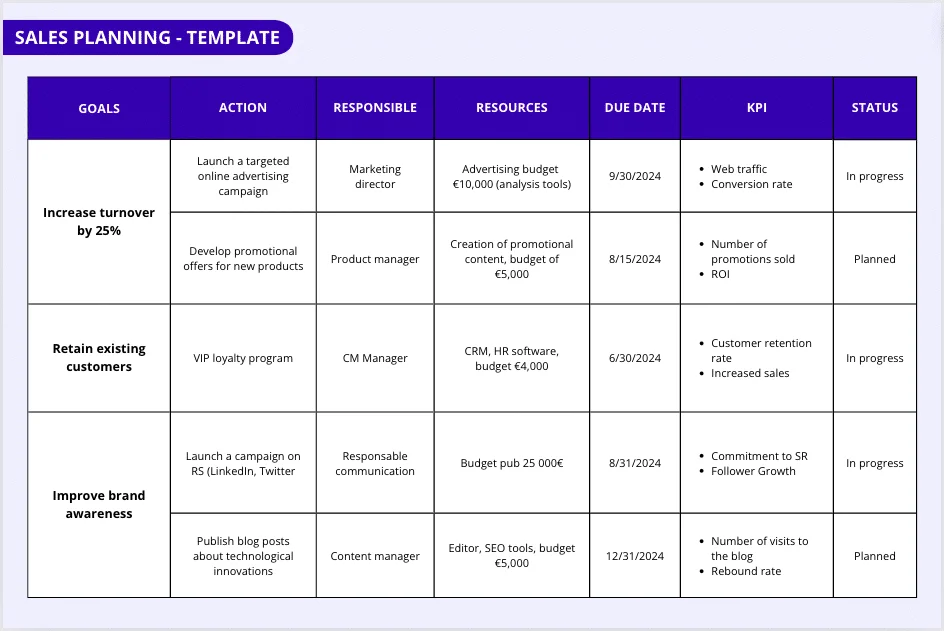
If you'd like to get this sample sales action plan for free, you can click on the little alien button. 👽
Advantages and disadvantages of sales planning
If you're still in any doubt about the power of a sales action plan, here are a few pros and cons to consider. 😊
Category | Advantages | Disadvantages |
|---|---|---|
Clarity and direction | Provides a clear vision of what needs to be done to achieve business objectives. | Can become too rigid and not allow enough flexibility to adapt to rapid market changes. |
Resource optimization | Allows better allocation of human, financial and material resources. | May require an initial investment of time and money to develop. |
Performance Improvement | Facilitates monitoring and evaluation of business performance, enabling real-time adjustments. | The quality of results depends on the accuracy of the data and analysis used to develop the plan. |
Strategic Alignment | Ensures that all team members are working towards the same objectives and priorities. | Can lead to team overload if objectives are not realistic or well defined. |
Anticipation of Challenges | Helps anticipate and overcome potential obstacles through proactive planning. | May not take into account all unforeseen events or rapid changes in the external environment. |
Team Motivation | Motivates sales teams by providing clear objectives and tangible rewards. | Can cause demotivation if objectives are perceived as unattainable or unrealistic. |
Customer loyalty | Improve customer satisfaction and loyalty through a more structured and personalized approach. | Implementing loyalty strategies can be costly and time-consuming. |
Performance measurement | Makes it easy to measure progress and evaluate performance using key performance indicators (KPIs). | Requires effective monitoring and reporting systems, which can represent an additional cost. |
How about a recap?
If you follow the key steps explained above, you'll be able to increase 🚀 your chances of success.
Even if implementing a plan like this requires a certain investment in time and resources, the various benefits(strategic alignment, improved performance, optimization of resources) will ensure great growth. 😇
Frequently asked questions
How to draw up a sales action plan?
To draw up a sales action plan, here's a list to treasure 💎 :
1️⃣ Analysis of current situation.
2️⃣ Definition of sales objectives.
3️⃣ Target identification.
4️⃣ Develop sales strategy and policy.
5️⃣ Action planning.
6️⃣ Implementation and follow-up.
7️⃣ Evaluation and adjustment.
What are the different types of sales actions?
There are different types of sales actions that companies can take to achieve their sales objectives: 👇🏼
Commercial prospecting.
actions.
Sales promotion.
Advertising and communication.
Networking actions.
Digital actions.
After-sales service.
Cross-selling and up-selling.
How to draw up an action plan table?
Drawing up an action plan in the form of a table makes it easier to structure and track the various steps and actions required. Here's an example. ⬇️
Target | Action | Responsible | Deadline | Performance Indicators (KPIs) | Status |
|---|---|---|---|---|---|
Increase sales by 20%. | Launch online advertising campaign | Marketing Manager | September 30th, 2024 | Increase web traffic, conversion rate | In progress |
Retain existing customers | Implement loyalty program | CRM manager | June 30, 2024 | Retention rate, increase in recurrent sales | In progress |
Well, what are you waiting for to start your sales planning ? 😏