
Somewhere between 20% and 50% of leads never get contacted. The main reason? Poor lead routing. 🥲
Lead routing is the process of assigning a lead to the right person at the right time so they can take action quickly.
But today, it goes far beyond your CRM. The real challenge starts before the assignment (when should you activate the lead? and on which channel?) and continues after the lead is assigned.
Here’s how to structure your lead routing to boost conversions and grow your pipeline. 👀
What is lead routing?
In practice, when a prospect fills out a form, downloads content, books a demo, or interacts with your brand, a few things need to happen:👇🏻
Be identified.
Be qualified.
Be assigned.
Be contacted.
Lead routing happens during the assignment stage. It’s usually based on criteria like:
🌍 Territory (country, region).
🏢 Company size.
🏭 Industry.
🧩 The product or offer concerned.
📅 Sales representative availability.
The goal is simple: respond faster and prevent leads from slipping through the cracks in your CRM.
But in modern sales organizations, this definition is no longer enough. 🫠
The new definition of lead routing
Today, lead routing isn’t just about deciding who gets the lead. It’s about answering a few key questions:
⏱️ When should the lead be activated?
📲 Which channel should you use (email, phone, LinkedIn, etc.)?
👤 Who should handle it?
🔥 How urgent is it?
📊 Under which SLA (Service Level Agreement) should it be handled?
Lead routing should not be the last step in lead management... but rather an organizational mechanism.
Does lead routing really improve conversions?
Yes and not just a little. 😎
Lead routing directly impacts three major drivers of sales performance. 👀
1) Impact on Conversion Rates
The most important factor is lead response time. ⏳
A lead contacted within one hour of their request is seven times more likely to start a sales conversation than one contacted later. In some B2B sectors, the first 15 minutes make all the difference. ⏱️
Why?
🔥 The buying intent is still strong.
🧠 The prospect is still thinking about the problem.
🏁 You reach them before your competitors.
Effective lead routing automates assignment, triggers instant notifications, ensures SLAs are respected, and improves conversion rates.
2) Impact on Pipeline Speed
Poor lead routing creates hidden friction in the sales process:
Leads assigned to the wrong territory. 🌍
Leads transferred manually between sales reps. 🔄
Leads forgotten in a “New” or “Unassigned” status. 💤
Leads that don’t get processed because ownership isn’t clear 🤓
As a result, you lose leads... and lost revenue.
When routing is clear and automated, the right Sales Person handles the lead immediately, making the pipeline smoother and shortening !
3) Impact on Sales Team Fairness
This is an often overlooked aspect. Manual lead routing often favors 👇🏻:
The most visible sales reps.
Certain priority territories.
Simple human bias in lead distribution.
An automated system ensures fair distribution, balanced workloads, and better allocation of strategic accounts. 🧩 The result?
📈 Less internal frustration.
💪 More motivated sales teams.
🚀 More consistent collective performance.
The 5 Steps to Implementing Effective Lead Routing
Implementing effective lead routing isn’t just activating a rule in your CRM. It’s a structured RevOps project. The good news? It’s much easier to implement than it sounds. 😉
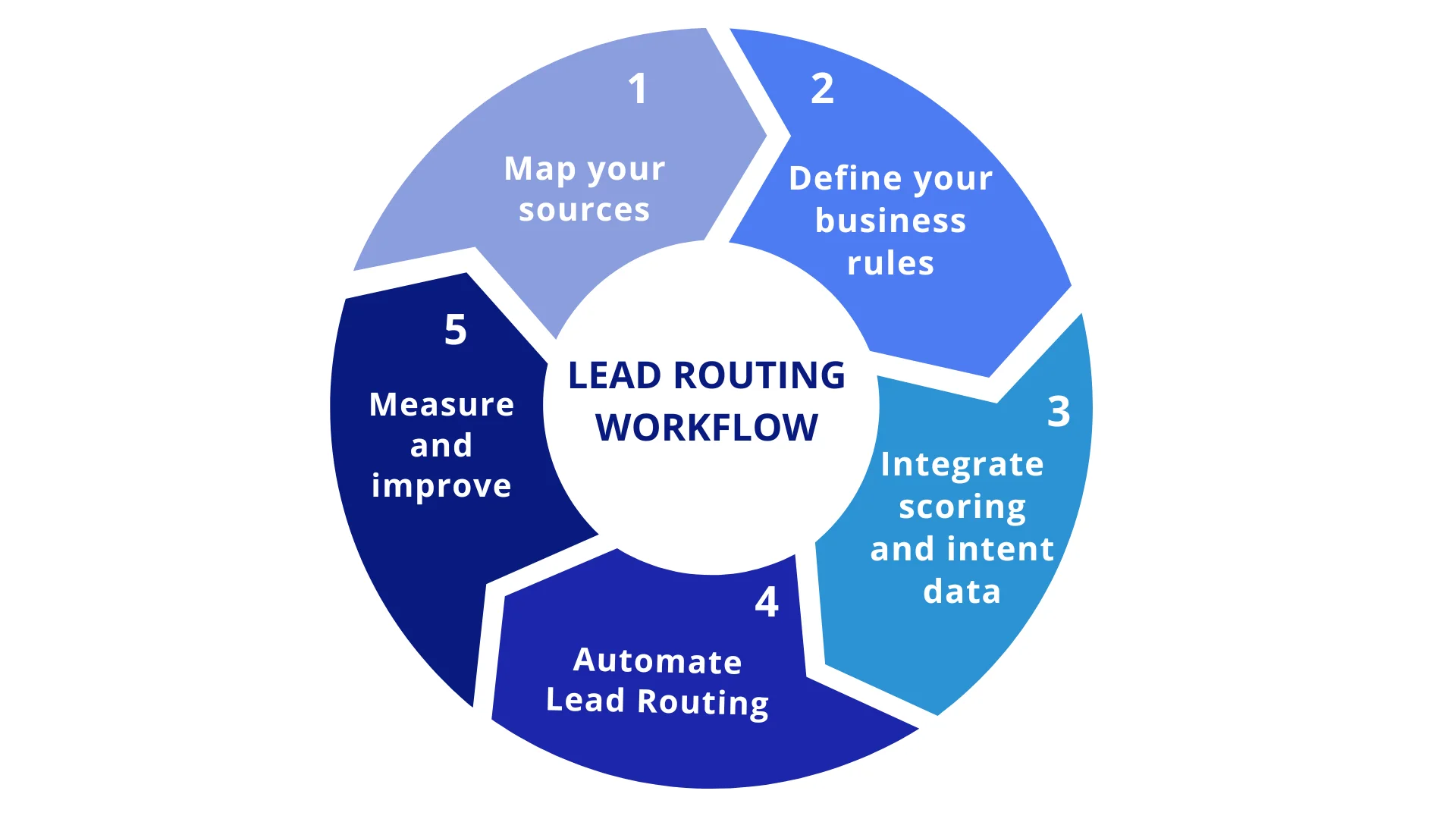
Step 1: Map Your Lead Sources (Before the CRM)
The real routing challenge starts before the data even reaches your CRM.
Start with a simple question: Where are your leads actually coming from?
In most companies, they typically come from:
🌐 Inbound lead (forms, demos, content).
💼 LinkedIn (organic or social selling).
💰 Paid ads.
📞 Outbound (SDR, cold outreach).
Not every source has the same level of intent. A demo request ≠ an eBook download ≠ a LinkedIn interaction. If you treat them all the same, you weaken your results. Segment your lead flows from the start. 🤓
The classic mistake is to start with the rules in the CRM. Start with business logic. Define:
Step 2: Define Your Business Rules (Not Technical Ones)
The classic mistake is starting with CRM rules first. Instead, start with your business logic. Define things like:👇🏻
⏱️ Your SLAs (e.g., 15 minutes for a demo, 24 hours for an MQL).
🔥 Priority levels.
💰 Target deal size.
🌍 Territorial rules.
🧩 Product specialization.
CRM should only be an execution layer. The strategy should be revenue-driven, not tool-driven. 📊
Step 3: Integrate Scoring and Intent Data
Good routing doesn’t rely only on static rules anymore. You should also incorporate:
📊 Lead scoring (fit + engagement).
🔎 Intent signals (pricing, key pages, repeat visits).
👀 Social signals (LinkedIn interactions, recent activity).
You move from passive routing to predictive routing. 😎
Step 4: Automate Lead Routing
If nothing happens after assignment, the lead just sits in the CRM tool... and the opportunity quickly fades. 🥲
That’s why lead routing needs to be connected to your activation stack: CRM, email, phone, LinkedIn, and automation platforms. Automation makes it possible to:
⚡ Automatically trigger first-touch actions (email, LinkedIn sequence, etc.).
🔔 Notify the sales rep instantly when a lead is assigned.
⏱️ Ensure SLAs are met by shortening first reply times.
The lead is activated immediately without relying on manual actions. In other words, routing shouldn’t just change the lead owner in the CRM. It should automatically trigger sales engagement actions. 👩🏻💻
Step 5: Measure and Improve
To track performance, set up a dedicated dashboard in your routing or RevOps tools so you can monitor key performance indicators. 📊
Which KPIs should you track? Here are a few of the most important ones:
KPI | What It Measures | Why It Matters |
|---|---|---|
⏱️ Average time to first response | Time between lead creation and first sales contact | Has a direct impact on conversion rates |
📊 % of SLAs met | Percentage of leads contacted within the defined timeframe | Confirms that your routing process is working properly |
📈 Lead → SQL conversion | Percentage of leads qualified by sales teams | Indicates whether routing and prioritization are effective |
💰 SQL → Opportunity conversion | Percentage of SQLs that become real opportunities | Shows whether the right leads reach the right sales reps |
A dashboard like this helps you quickly spot issues. 🕺🏻
How Does Lead Routing Work?
Not all lead routing methods deliver the same results.
The right approach depends on your RevOps maturity, team structure, and your main objective: fairness, performance, or strategic prioritization. 🎯
Here are the most common lead routing approaches. 👇
Rule-Based Lead Routing
In this model, leads are assigned based on predefined business rules, such as:
🌍 Country or territory.
🏭 Industry.
🏢 Company size.
🧩 Product or offer the lead is interested in.
This is the most common model used in CRMs. It aligns lead routing with your sales organization and territories, but it can become difficult to manage as the number of rules grows. 🫠
Round Robin
Round Robin distributes leads sequentially among sales reps. Each new lead goes to the next rep in the rotation. 📋
➡️ This system is:
Simple to implement.
Fair in terms of lead distribution.
Well suited for homogeneous teams (same role, same segment).
⚠️ However, it doesn’t account for lead quality or individual rep performance.
Weighted routing
Weighted routing distributes leads according to certain performance or capacity criteria. Such as:
📊 Sales rep performance.
🎯 .
💰 Average deal size.
📈 Current capacity or workload.
This model allows you to send more leads to top performers or balance workloads across the team. However, if it isn’t calibrated correctly, it can create internal imbalances. ⚖️
Here is a brief summary:
Method | Complexity | Automation Level | Conversion Impact | Ideal For |
|---|---|---|---|---|
Round Robin | Low | Medium | Medium | Homogeneous sales teams |
Rule-based routing | Medium | High | Good | Organizations structured by territory |
Weighted routing | High | High | Good to very good | High-performing teams with reliable data |
Manual vs. Automated Lead Routing: Which Should You Choose?
Manual lead routing can work in the early stages. But as lead volume grows, it quickly becomes fragile: assignment delays, missed leads, limited SLA visibility, and ultimately lost performance. 😒
Automation, on the other hand, structures the process, reduces risk, and makes performance measurable. 📊
Here’s a quick comparison:
Criterion | Manual routing | Automated routing |
|---|---|---|
Assignment time | Variable | Instant |
Risk of error | High | Low |
SLA compliance | Inconsistent | Trackable and measurable |
Scalability | Limited | High |
Fairness | Subjective | Structured and consistent |
Impact on conversion | Medium | Strong |
Which automated lead routing software choose?
Not every company needs the same level of routing complexity. Whether you rely on native CRM routing, specialized tools, or automation connectors depends on several factors:
Your lead volume.
The complexity of your routing rules.
Your existing tech stack.
Your RevOps maturity level.
Here are the main options: 👇
Category | Tools | Ideal For | Strengths | Limitations |
|---|---|---|---|---|
CRM with native routing | HubSpot, Salesforce | Teams already structured around a CRM | Native integration, easy to activate, centralized management | Limited advanced logic and restricted intent-based routing |
Specialized routing tools | LeanData, Zendesk Sell, dedicated rules engines | Multi-territory or multi-segment organizations | Advanced routing, SLA management, complex workflows | Higher cost and reliance on CRM integrations |
Automation tools (connectors) | Zapier, Make | Agile teams with modular stacks | High flexibility, tool integrations, and custom triggers | Requires maintenance and can become complex over time |
How Can Lead Routing Be Complemented by Multichannel Activation?
Most lead routing process stop at one thing: assigning the lead inside the CRM. 🥲
But in practice, the real problem often begins before and after this step: 👇🏻
Before: Detecting when to activate a prospect and on which channel.
After: Ensuring that the lead is actually contacted quickly.
This is where a multichannel approach with Waalaxy can strengthen your routing strategy. 😎😎
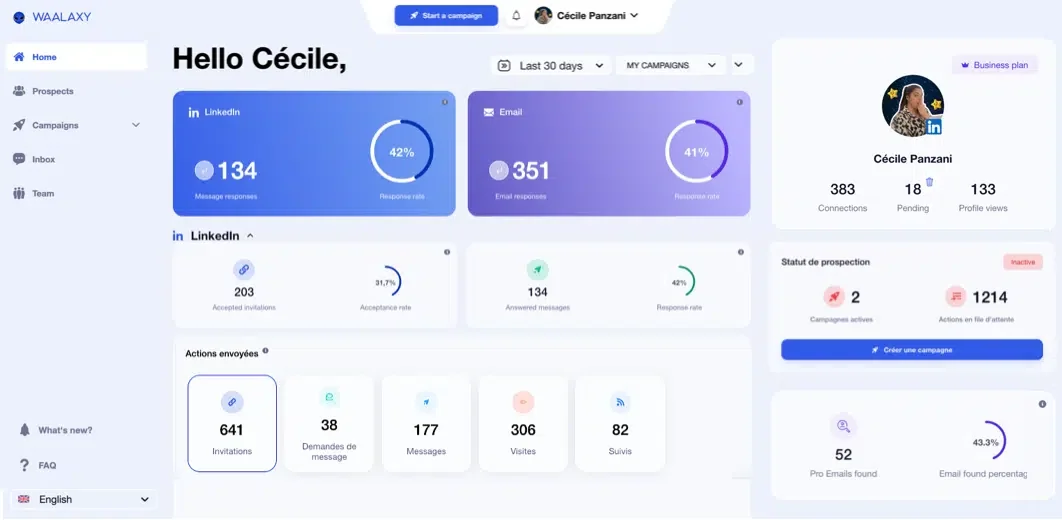
Instead of limiting routing to internal CRM distribution, the idea is to add a sales activation layer around it. ✨
In practice:
🔥 Before the CRM: Capture buying signals and start conversations earlier.
⚡ After assignment: Automatically trigger outreach via LinkedIn or to accelerate the first interaction.
🔁 Connect your existing stack through tools like Zapier.
🤝 Work alongside CRMs like HubSpot or Salesforce.
The goal is not to replace your CRM, it’s to enhance it with multichannel activation. 🤓
Lead Routing + Intent Data: The New Winning Combo?
Adding intent data to lead routing moves you from a static system to a dynamic one. 🤸🏻♀️
You’re no longer routing based only on “who should handle this lead.” Instead, you route based on “who should handle it right now.”
1) Prioritize Leads Based on Intent
Two companies may have exactly the same profile... but not the same level of urgency. 🚨
For example, a prospect who:
Visits your pricing page several times.
Downloads content (, PDF, etc.).
Interacts with your LinkedIn content.
Returns to your site regularly...
shows a much stronger buying signal. These signals allow routing to automatically:
🔥 Increase the lead's priority.
⏱️ Reduce the contact time (SLA).
👤 Assign the lead to a more experienced sales rep.
This moves you from an administrative routing system to a predictive, conversion-focused one. 📈
2) Adapt Routing to Time Zones and Territories
In an international prospecting context, timing becomes even more critical. ⏳
A lead generated at 10 p.m. in Europe shouldn’t have to wait until the next day if a US-based team can respond immediately. Advanced routing can automatically 👇🏻:
⏰ Identify the prospect’s time zone.
😴 Check team availability.
📨 Adjust lead assignment accordingly.
This ensures continuous sales responsiveness, regardless of location. ⚡
3) Balance Performance and Fairness
The goal isn’t to send every hot lead to the same sales reps. A strong lead routing system should balance:
🚀 Maximizing sales performance.
⚖️ Maintaining fair lead distribution.
🎯 Respecting business priorities.
This combination of business rules, intent signals, and automation turns lead routing into a true RevOps engine. 🛠️
Let's recap on lead routing!
Between 20 and 50% of leads are never contacted.
The problem? Poorly structured routing. 🥲
Lead routing is no longer just about assigning a lead inside a CRM. It’s about deciding who should handle a lead, when to activate it, how to reach out, and how urgent it is.
When done right, lead routing helps you:
📈 Increase conversion rates.
⚡ Accelerate pipeline velocity.
⚖️ Ensure fair lead distribution.
🎯 Reduce lost or ignored leads.
And most importantly, it doesn’t stop at assignment.
By connecting it to multi-channel activation with a lead routing tool like Waalaxy, you go from simple routing to a true sales and marketing organization in your lead management (LinkedIn + Email, before and after CRM). 🚀
Lead Routing FAQ
5 Lead Routing Best Practices
Here are the key best practices: 😎
🔍 Map all your lead sources (before they enter the CRM).
📏 Define clear SLAs.
📊 Integrate lead scoring and intent data.
🔁 Automate lead management and notifications.
📈 Track key KPIs (response time, SLA compliance %, Lead → SQL).
And most importantly, connect routing to sales activation so leads are contacted quickly. 🏃🏻♀️
What is lead scoring and routing?
Lead scoring and lead routing are complementary, but they answer different questions:
Lead scoring: Is this lead a priority? 📊
Lead routing: Who should handle it and when? 🎯
Scoring evaluates quality and intent.
Lead routing evaluates assignment and activation. 😎
Criterion | Lead Scoring | Lead Routing |
|---|---|---|
Main question | Is this lead worth following up on now? | Who should handle it, and within what timeframe? |
Objective | Prioritization | Assignment + activation |
Based on | Fit (ICP, company size, industry) + engagement | Territory, business rules, SLA, intent data |
Direct impact | Pipeline quality | Speed and conversion |
Role in the process | Qualification | Sales orchestration |
What is a lead routing platform?
A lead routing platform automatically assigns incoming leads to the right salesperson or team based on predefined rules (territory, company size, product interest, or priority).
Instead of distributing leads manually, it sends each lead to the right person at the right time, helping sales teams respond faster and increase conversions. 🚀
What Are the Most Common Lead Routing Mistakes?
Routing seems simple on paper. However, if poorly structured, it can slow down your entire sales machine. Lead routing seems simple on paper. But if it’s poorly structured, it can quietly slow down your entire sales machine.
Here are some of the most common mistakes: 👇
❌ Confusing assignment with activation: Changing the owner in the CRM doesn’t guarantee the lead will actually be contacted.
❌Not defining a clear SLA: Without a defined reply time (15 minutes, 1 hour, 24 hours, etc.), accountability disappears.
❌ Ignoring time zones in global sales teams: A hot lead that waits 12 hours because of a time difference is rarely still hot. This is especially critical for international prospecting.
❌ Not connecting scoring and routing: Without intent data, you’re routing blindly.
❌ Not measuring routing performance: Response time, SLA compliance, Lead → SQL conversion… If you don’t measure it, you can’t improve it.
Poorly structured routing rarely triggers an alert. Instead, it creates invisible delays and lost conversions. 📉
Should You Adapt Lead Routing to the Size of Your Sales Team?
Yes, absolutely. 😌
A routing system designed for a team of three sales reps won’t work for an organization with:
Multiple territories.
Multiple segments (SMB, Mid-Market, Enterprise).
Specialized roles (SDR, Account Executive, Account Managers).
As the organization grows, lead routing needs to become more structured. It should include priority levels, differentiated SLAs, and sometimes automatic reassignment logic.
The larger the sales organization, the more routing must evolve from simple distribution to structured sales orchestration. 🎯
Now you know how to set up lead routing! 🧚🏻♀️